
I-105 ExpressLanes Equity Assessments: Key Successes and Lessons Learned
Historical Context
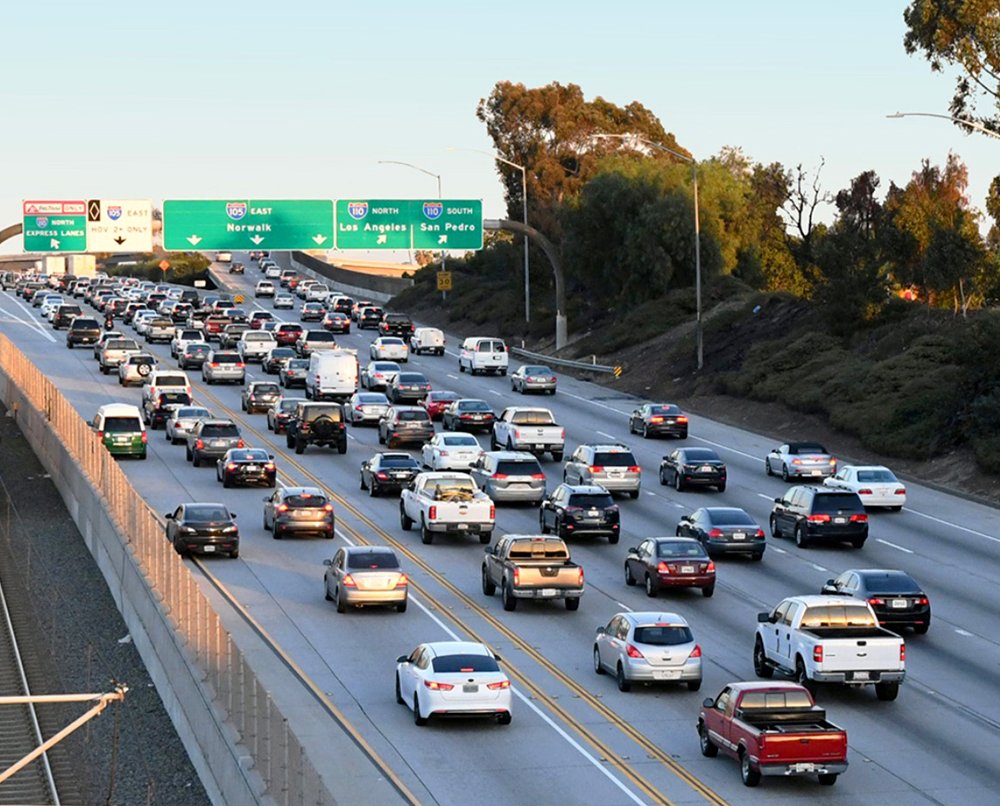
The planning, design and construction of the Interstate 105 (I-105) freeway sparked civic conflict that significantly influenced future freeway development across LA County. Beginning in the late 1960s and early 1970s, the State of California acquired significant property, including residential homes, to construct the I-105 freeway within the proposed right-of-way. In 1972, a federal lawsuit was filed a month before groundbreaking, preventing the state from acquiring property until environmental studies were approved. The suit also alleged inadequate relocation assistance, denial of equal protection to minorities and low-income residents, inadequate public hearings and violation of due process.
The government was ordered to cease evictions along the proposed freeway route—other than those involving voluntary relocation or deemed necessary to protect public health and safety—and instituted new acquisition proceedings. At the time of this ruling, over half of the needed parcels had been acquired and 35 percent had already been cleared.
The ruling halted freeway construction for seven years. Meanwhile, the abandoned neighborhoods in the corridor deteriorated, increasing pressure from corridor cities for freeway completion. The plaintiffs and Caltrans reached an initial agreement establishing a revised project design that included six lanes for general traffic, two HOV lanes, metered ramps, a median transit system no wider than 64 feet that could be later converted to light rail and the construction of 3,700 new housing units. This agreement marked the first time federal highway funds had been used to mitigate impacts on local housing and residents. Groundbreaking occurred in Lynwood on May 1, 1982. The I-105 freeway opened to traffic in 1993.
Today, the communities along the I-105 are unique and multi-faceted. Each community has been shaped by its history and diverse demography. However, many communities along the I-105 corridor experience significant disparities in income, health, housing, services, education and mobility access compared with the Los Angeles County average. One way to address these disparities is by improving mobility and access to opportunity. Metro’s ExpressLanes project aims to create a more equitable, multimodal transportation system along the I-105 corridor by enhancing mobility and diverting traffic from local arterial streets onto the I-105 freeway.
I-105 ExpressLanes Project Description
The I-105 is an east-west freeway that connects El Segundo and the Los Angeles International Airport (LAX) to the City of Norwalk. Metro is currently converting the existing I-105 High Occupancy Vehicle (HOV) lane, or carpool lane, into two Metro ExpressLanes in each direction. These ExpressLanes will be available for use by all motorists, with single occupant drivers paying a toll and buses and carpools traveling toll-free. Project objectives and goals include:
- Enhancing freeway operations and safety by improving traffic flow and reducing stop and go conditions
- Easing congestion by improving travel speeds on the ExpressLanes to meet the federal standard
- Reducing freeway overflow traffic onto nearby city streets
- Equitably reinvesting the revenue from the use of ExpressLanes in mobility improvements and transit projects in communities along the corridor to improve travel times, convenience and affordability across all modes to advance local and regional equity goals
- Improving mobility and accessibility to economic opportunities for communities along the I-105 corridor
The I-105 ExpressLanes project is ongoing, and the project webpage provides regular status updates. Construction on Segment 1—from Sepulveda Boulevard to Central Avenue—is underway and expected to be completed in 2028. Construction for Segment 2 (Central Avenue to I-710) and Segment 3 (I-710 to Studebaker Road) is anticipated to begin in mid-2026 and be completed in 2029.
Equity Approach for the Project
To guide equitable investment of future net toll revenues, the Metro ExpressLanes team completed an Equity Assessment for each project segment to identify transportation projects that will further enhance mobility, accessibility, connectivity and equity for nearby communities as well as all users of the I-105 corridor. The Equity Assessment for Segment 1 was completed in 2024 and the Equity Assessment for Segments 2 and 3 was conducted in 2025. Through engagement with communities along the corridor, the project team identified active transportation, transit and roadway projects that could be funded with I-105 ExpressLanes toll revenue to enhance mobility, accessibility and connectivity. Metro, in collaboration with community members, then prioritized the projects by considering demographic factors, transportation data, existing conditions and community and environmental benefits. Projects funded by future toll revenue will expand safe, accessible multimodal options, enhance connectivity to essential services and opportunities and improve the quality of life for communities along the I-105 corridor.
Community-based organization (CBO) advisors collaborated with Metro throughout the Equity Assessment and project prioritization process. Metro met monthly with advising CBOs to better understand each community’s unique needs and recommendations. Additionally, Metro’s outreach team organized engagement opportunities and attended wide-ranging community events to build relationships with residents and stakeholders. These engagement efforts included launching a travel survey to collect community member travel behavior data and hosting public meetings to collect potential project input. This input was used to create profiles of surrounding communities within the project area and develop criteria to determine which projects should be prioritized. Public engagement was critical to the development of the project list, evaluation criteria and recommendations.
Key Successes
Understanding Neighborhood Context
The project team developed a series of neighborhood profiles for cities and neighborhoods along the corridor to provide historical and demographic context for project impacts. The profiles helped Metro develop preliminary insight into each neighborhood through historical and quantitative lenses, as well as a more nuanced understanding of lived community experiences. This process further contextualized and informed the project prioritization process. To read more about these profiles:
Segment 1 Communities: Compton, El Segundo, Gardena, Hawthorne, Inglewood, Lawndale, Lynwood, South Gate; Los Angeles – LAX/Westchester, Harbor Gateway, South LA; Unincorporated LA County – Del Aire and Lennox, Florence-Firestone, Westmont and West Athens, Willowbrook/West Rancho Dominguez
Segment 2 and 3 Communities: Artesia, Bellflower, Cerritos, Compton, Downey, La Mirada, Long Beach, Los Angeles (South LA), Lynwood, Norwalk, Paramount, Santa Fe Springs, South Gate; Unincorporated LA County – East Rancho Dominguez, Florence-Firestone, Willowbrook/West Rancho Dominguez
Community Voices Inform Project Reinvestments
Metro employed a wide array of community engagement strategies to maximize public collaboration and feedback related to project development so reinvestments reflect community need. The effort to incorporate community voices and equity considerations in the decision-making process also enabled the project team to build trust with members of the community and increased project alignment. Some of the community engagement strategies included:
CBO Meetings: The project team hosted 10 monthly roundtable meetings to engage the project’s CBO partners (16 CBO partners for Segment 1 and 21 CBO partners for Segments 2 and 3). These meetings allowed the project team to gain a better understanding of unique community needs, collaborate on identifying potential community-centered projects and finalize a prioritized project list to share with the community and Metro Board. Monthly CBO roundtable meetings were held during the lunch hour to facilitate CBO participation, and CBOs were compensated $100 per roundtable meeting. Additionally, the project team scheduled one-on-one meetings with CBOs on request to make participation easier and maximize community input.
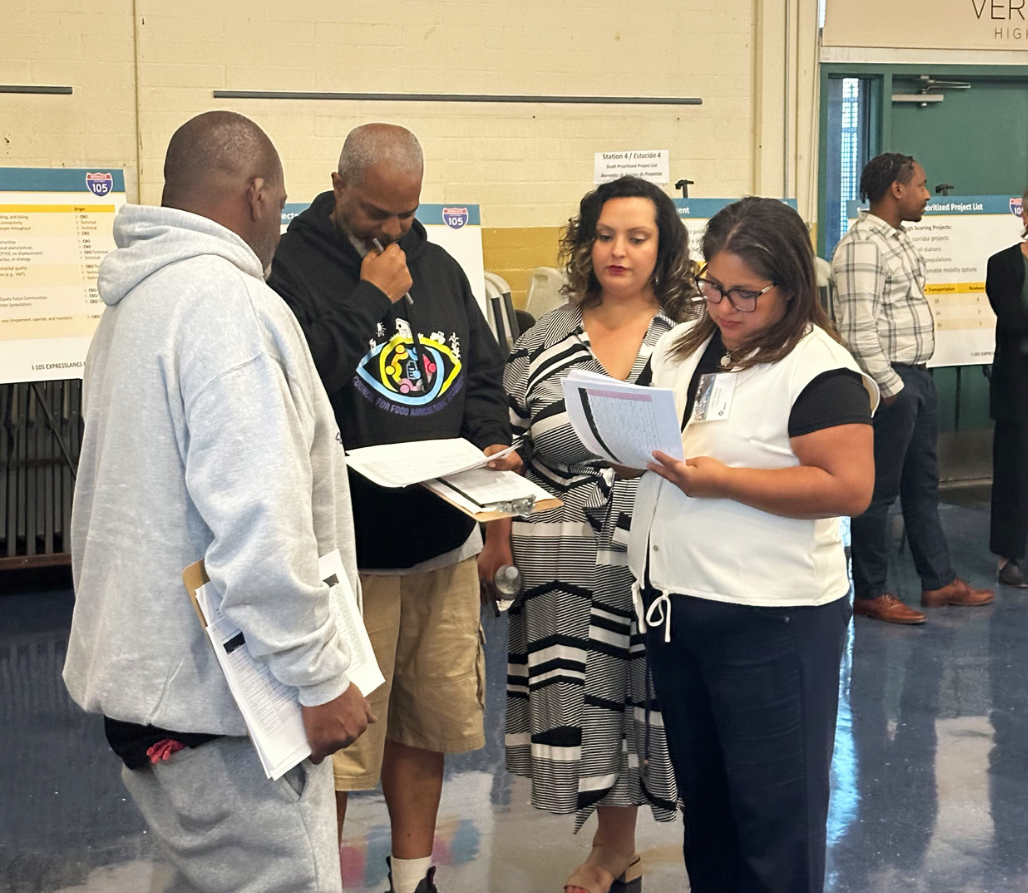
Walk and Mobility Audits: Metro and CBO partners conducted walk and mobility audits to build a foundational understanding of the I-105 assessment area’s current transportation system. Participants took notes of their observations and brainstormed potential improvements with the project team during audit debriefs. These locations were selected based on data analysis, CBO feedback and the 78-square-mile assessment area’s geographic representation. These areas included:
- Segment 1: A half-mile radius walk audit around the Metro Avalon and Hawthorne/Lennox Stations.
- Segment 2 and 3: Metro and CBO partners split into three groups to conduct a bike, transit and walk audit between Willowbrook/Rosa Parks Station, Lynwood Station and Lakewood Blvd Station.
Field Visit: Metro hosted a field visit with local city staff and CBOs at Norwalk Station in August 2025 to foster interagency coordination on Metro’s Norwalk Mobility Hub, Reconnecting Communities projects and Caltrans’ 1-105 safety improvements project. Staff led two groups on a walking tour, describing potential project elements.
Surveys: Metro engaged nearly 4,000 residents to support a travel survey in both English and Spanish. Metro also launched a survey for Segment 1 to present the project lists to the public and facilitate feedback on project prioritization.
Transit Intercepts: The outreach team and CBO partners conducted transit intercepts at some of the busiest bus and rail stations throughout the project corridor to provide transit riders travel survey flyers and encourage them to complete the survey while waiting for, or during, their ride. In addition, the CBOs assisted with survey distribution to their members.
Visit the Engage Stakeholders page for more information on community engagement strategies like those employed during this project.
Challenges and Lessons Learned
The project team encountered several challenges during the Segment 1 Equity Assessment process that informed key lessons learned and solutions applied for Segments 2 and 3. These included:
Project Prioritization Recalibration
Challenge: During Segment 1, Metro discovered the project prioritization process needed to be recalibrated—the project list was too long for meaningful review.
Lesson Learned: To make the process more manageable and effective for CBOs during Segments 2 and 3, the project team grouped potential projections into categories and reduced their number from over 130 to 50. By categorizing and reducing the number of projects, the team was able to better communicate technical details and next steps, as well as more effectively collaborate with engaged CBOs.
Public Engagement
Challenge: During Segment 1, direct community engagement included one in-person and one virtual public meeting, as well as CBO partner roundtables. The project team relied heavily on CBOs to promote the events and encourage public meeting attendance. However, public attendance and involvement, and thus feedback, at times felt limited.
Lesson Learned: The project team doubled the number of in-person community meetings, and integrated CBO 1:1s to maximize feedback during the Segments 2 and 3 Equity Assessment process. This included efforts to meet CBOs where they were, both figuratively and literally—including through routine meeting locations. In the future, Metro may wish to collaborate with partners on outreach efforts to increase public attendance and maximize community feedback.
For more information about the I-105 ExpressLanes project, including additional details about the Equity Assessments, visit the project webpage.